
What are the most common mistakes when packaging medium- and large-sized products?
Industrial packaging goes far beyond simply wrapping a product for transport. When working with medium- and large-sized products — such as doors, panels, furniture, sanitary ware, building materials or industrial components — any error during the packaging process can result in damage to the product, logistical delays, increased costs and a loss of competitiveness.
In many cases, these problems are not related to the quality of the packaging material, but rather to the use of equipment that is unsuitable for the product’s characteristics or to processes that rely too heavily on manual labour.
Therefore, choosing packaging machinery specifically designed for this type of application is key to ensuring product protection and optimising plant productivity.
At CMB, we have been developing industrial packaging machinery for medium- and large-sized products for over 40 years. Our solutions enable the automation of end-of-line processes, improve operational efficiency and reduce incidents arising from inadequate packaging.
Mistake 1: Using the same packaging solution for products with different characteristics
One of the most common mistakes is attempting to pack all products using a single system, regardless of their dimensions, weight or the level of protection required.
However, a lacquered wooden panel does not require the same packaging as a large door or a ceramic sanitary ware item. Each product has specific requirements that determine the type of machinery and protective materials that must be used.
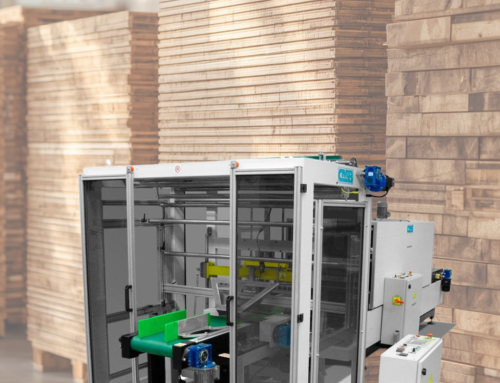
At CMB, we develop solutions capable of adapting to different product formats and configurations. Equipment such as the ERL enables products of varying dimensions to be automatically wrapped in stretch film, ensuring uniform packaging and high load stability without compromising productivity.
Error 2: Failure to provide adequate protection during transport
Much damage occurs when packaging does not offer sufficient protection against impacts, vibrations, abrasion or moisture.
For high-value-added products, any surface damage can lead to returns, complaints or even the loss of the product before it reaches the end customer.
To minimise these risks, CMB offers specific solutions such as COOLPACK, a cold packaging system that combines stretch film and bubble wrap to create a double protective barrier. This system provides particular protection for the delicate finishes of doors, panels, furniture and other large items, significantly reducing incidents during handling and transport.
Furthermore, as it is a cold-packaging technology, it eliminates the need to use heat during the process, improving the facility’s energy efficiency.

Mistake 3: Using more material than is actually necessary
There is a misconception that using more material equates to greater protection. However, oversized packaging increases costs, generates more waste and does not always improve product safety. The key lies in applying exactly the level of protection required for each item.
With this in mind, CMB has developed solutions such as SUPER P, a system that allows additional protective materials to be incorporated only when the application requires it. Bubble wrap, corrugated cardboard, kraft paper or polyethylene foam can be intelligently combined to protect the most sensitive areas of the product, whilst optimising material consumption and reducing the environmental impact of the process.
Mistake 4: Maintaining manual processes that reduce productivity
As production increases, manual packaging processes often become one of the main bottlenecks in the factory.
Manual packaging increases working times, hinders process repeatability and raises the risk of ergonomic injuries when handling heavy or bulky products.
The machinery developed by CMB enables the automation of packaging for medium and large-sized products, resulting in much faster, more consistent and safer processes.
As well as boosting productivity, automation improves the consistent quality of packaging and significantly reduces reliance on manual intervention.
Mistake 5: Choosing machinery without considering energy efficiency
Sustainability has evolved from being an added value to becoming a key decision-making criterion for many industrial companies. However, there are still facilities that use energy-intensive technologies or inefficient processes.
CMB’s cold packaging solutions, such as ERL and COOLPACK, eliminate the need to use heat to secure the packaging, reducing the facility’s energy consumption and simplifying equipment maintenance.
Furthermore, they use recyclable materials and optimise material usage thanks to precise application systems that minimise waste. This combination helps to reduce both the operating costs and the environmental impact of the packaging process.

Why does CMB’s machinery help to prevent these errors?
Experience shows that an efficient packaging system must adapt to the product, and not the other way round.
That is why, at CMB, we design each project taking into account the specific characteristics of the product, the production rate, the logistical requirements and the objectives of each client.
Our machines enable the automation of processes, improved product protection and optimised material consumption, offering solutions specially designed for medium- and large-sized products.
The combination of technologies such as ERL, COOLPACK and SUPER P allows different levels of protection to be configured according to the requirements of each application, always ensuring consistent, secure and efficient packaging.
Avoiding the most common mistakes in industrial packaging starts with choosing the right machinery. At CMB, we have been developing specific solutions for medium and large-sized products for over 40 years, helping companies worldwide to improve the efficiency of their production lines and protect their products throughout the logistics chain.
If you’d like to find out which solution best suits your production process, our technical team will be delighted to advise you and design a fully bespoke project.